
Hidden Fees Alert: How AI-Driven Exchange Rates Affect Your Transfer Cost
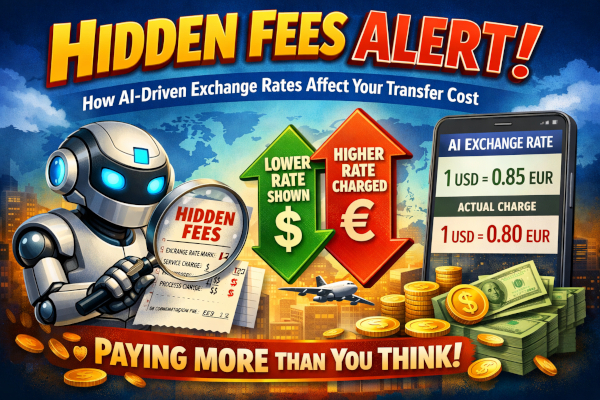
Hidden FX markups can add a surprising extra cost to your transfer, especially when providers use AI-driven, dynamic pricing models that constantly adjust the rate you see.
Mid-Market Rate vs “Guaranteed Rate”
The mid-market rate (also called interbank or real rate) is the midpoint between the buy (bid) and sell (ask) prices of two currencies in the global FX market. It is the benchmark rate banks and large financial institutions use when trading currencies with each other, free of retail markups or hidden margins.
Money transfer providers usually do not give customers the pure mid-market rate. Instead, they add a margin (for example 1–2% or more) on top of that benchmark and present it as your “customer rate” or “guaranteed rate,” effectively embedding part of their fee into the exchange rate.
How “guaranteed rates” hide fees
When a provider “locks” or “guarantees” your rate for several minutes or hours, it takes on market risk and typically compensates by widening the spread versus the mid-market rate. That extra spread means the recipient receives fewer units of the target currency than they would at the mid-market rate, even if the visible transfer fee looks low.
Example: one provider shows a mid‑market benchmark of £1 = €1.15, but offers you £1 = €1.13; on a £10,000 transfer the recipient gets €11,300 instead of €11,500, effectively paying a €200 hidden cost via the rate difference.
How to check the real spread
- Look up the live mid-market rate for your currency pair on an independent source (for example, a reputable FX benchmark or financial data site) right before confirming your transfer.
- Compare it to the rate your provider offers and calculate the percentage difference; banks and many providers often add around 1–2% or more as markup.
- Combine this hidden markup with the explicit fee to evaluate the total cost of the transfer, not just the advertised “no fee” or “low fee” claim.
How Dynamic, AI-Driven Pricing Works
Many modern providers use automated, algorithmic systems (often described as dynamic or FX‑driven pricing) that continuously update the exchange rate offered to customers. These systems monitor live FX markets and adjust retail rates according to a provider’s risk limits, desired margins, and market conditions, sometimes several times per minute.
In periods of high volatility or thin liquidity, providers may increase their margin or add a “dynamic” surcharge to cover the extra risk of guaranteeing you a fixed rate while the market moves. Some systems explicitly refresh the rate at short intervals (for example every 60 seconds) until your payment is received, which protects the provider from adverse moves but can also make it harder for you to capture sudden favorable swings.
From the user side, this means your rate is not only influenced by the underlying FX market, but also by the provider’s internal pricing algorithm and risk model. Two people sending the same currency pair at slightly different times can receive different “guaranteed” rates, even on the same day, purely because the dynamic model has updated its spread.
Why Weekends Are Still the Worst Time to Send
FX markets are most liquid when major financial centers are open and many participants are trading. During weekends, holidays, or off‑hours, participation falls sharply, available prices thin out, and liquidity providers widen their spreads to compensate for higher execution risk.
When spreads widen in the wholesale market, retail money transfer providers usually pass this on via worse customer rates or higher dynamic markups. Even if you can initiate a transfer at the weekend, the combination of thin liquidity and extra risk for the provider often results in noticeably less favorable exchange rates compared with active weekday sessions.
In practice, this means sending on a Saturday night or during public holidays can significantly reduce the amount your recipient receives, even if the fixed fee remains the same. For large transfers, this timing effect can easily translate into a loss of hundreds of units of the target currency compared with executing during a high‑liquidity weekday window.
Practical Ways to “Beat the System”
You cannot control interbank markets or a provider’s internal algorithm, but you can choose when and how you send. The following tactics focus on reducing the impact of dynamic pricing and hidden spreads on your transfer.
- Avoid weekend and holiday transfers: schedule large transfers for periods when major markets are open (for example, overlapping European and US hours) to benefit from tighter wholesale spreads.
- Check the mid-market rate in real time: verify the benchmark rate independently and calculate the markup before accepting a “guaranteed” rate, especially for high‑value transfers.
- Compare several providers at the same moment: use comparison tools that show both fees and customer rates relative to mid‑market so you can see total cost, not just headline fees.
- Use rate alerts and tracking tools: many FX information sites and specialist payment platforms allow you to set alerts when a currency pair reaches your desired level, helping you time large transfers more effectively.
- Split very large transfers: for non‑urgent moves, consider splitting a large amount into several smaller transfers over a few days, adjusting timing if markets become suddenly volatile and spreads widen.
- Prefer transparent mid-market pricing: some specialist providers explicitly state that they use the mid‑market rate plus a clearly disclosed fee, which can make total cost easier to understand and compare.
Key Takeaways for Smarter Transfers
For international transfers, the visible fee is only part of your true cost; the embedded exchange‑rate markup often matters more. Dynamic, AI‑driven pricing lets providers constantly adjust that markup in response to volatility, liquidity, and their own risk appetite, which can work against you if you send at the wrong time.
By understanding the gap between mid‑market and “guaranteed” customer rates, avoiding low‑liquidity periods like weekends, and using rate‑tracking tools to time large transfers, you can meaningfully reduce hidden FX costs. Over time, these habits help you keep more of your money on every cross‑border payment, rather than leaving it inside an opaque pricing algorithm.